

EV Test Equipment Market Growth Surge to USD 2,858.10 Million, at Accelerating CAGR of 28.90% Till the Forecast 2035
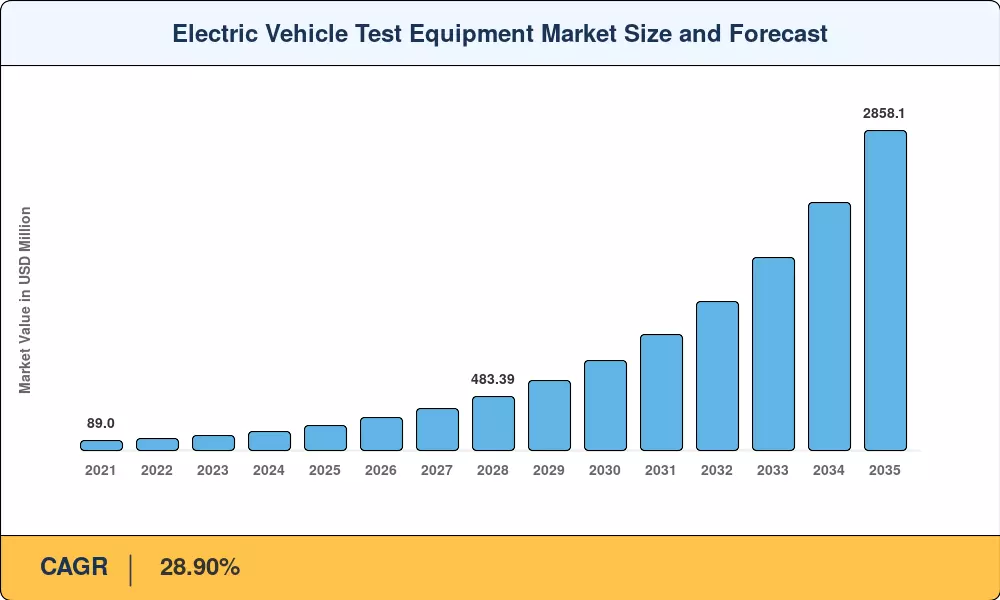
EV Test Equipment Market Summary
Asia-Pacific led the electric vehicle test equipment market with a 51.7% revenue share in 2024 and is the fastest-growing region at a 35.5% CAGR.
EV Battery Test Systems commanded approximately 44.6% of the 2024 electric vehicle test equipment market revenue, covering cell-level cycling, module abuse testing, and pack-level thermal validation.”
NY, CA, UNITED STATES, July 15, 2026 /EINPresswire.com/ -- Electric vehicle (EV) test equipment encompasses a broad range of specialized hardware and software systems used to validate the performance, safety, and durability of EV components and complete vehicles. This includes battery test systems for cell, module, and pack validation; powertrain test benches for electric motors and inverters; charging test systems for interoperability and safety compliance; and hardware-in-the-loop (HIL) platforms for software and electronic control unit validation. As EV production scales, this equipment has become essential for ensuring quality, regulatory compliance, and reliability.— Arti Dhapte
Electric Vehicle Test Equipment Market Overview
The electric vehicle test equipment market share reached an estimated USD 225.80 Million in 2025 and is projected to surge to USD 2,858.10 Million by 2035, registering a 28.90% CAGR across the 2026–2035 forecast window. Two forces are converging to accelerate spending: first, automakers worldwide are scaling production toward an expected 40 million battery-electric units per year by 2030, and each assembly line requires dedicated validation hardware before vehicles reach consumers. Second, tightening regulatory frameworks—particularly the EU Battery Regulation mandating digital battery passports by 2027 and UNECE R155/R156 cybersecurity type-approval deadlines—have compressed validation timetables and pushed OEMs to invest earlier in test infrastructure.
Industry trends indicate a decisive technology transformation in the migration from 400 V to 800 V—and emerging 900 V—drivetrain architectures. Legacy dynamometer and battery-cycling platforms designed for lower-voltage packs cannot safely handle the thermal management, insulation-resistance, and high-frequency switching demands of 800 V systems. Retooling these stations has become a multi-billion-dollar upgrade cycle; BloombergNEF estimates that global spending on EV production-line capital equipment surpassed USD 16 billion in 2024 alone, with test and validation benches representing a growing share of that outlay.
Technological developments are reshaping the market landscape. AI-accelerated test optimization through machine-learning systems can analyze cycling data in real time to identify cell-failure scenarios, reducing physical test cycles by 30–40%. Digital-twin simulations that mirror physical battery packs in real time can reduce physical cycling requirements by a third, compressing development timelines and lowering per-unit validation cost. Regenerative battery cyclers that recover 92–98% of discharge energy back to the AC grid are reducing laboratory electricity costs by up to 60%.
Get Free Sample Report for Detailed Market Insights:
https://www.marketresearchfuture.com/sample_request/25395
Electric Vehicle Test Equipment Market Segmentation
By Vehicle Type & Propulsion
Passenger Cars: Generated approximately 64.1% of 2024 revenue, reflecting the sheer volume of BEV sedan and SUV launches across global platforms
Commercial Vehicles: Fastest-growing vehicle-type segment at 36.9% CAGR, as electric bus and truck programs ramp up in China, Europe, and North America
Battery Electric Vehicles (BEVs): Accounted for roughly 69.4% of propulsion-type demand in 2024
Fuel-Cell Electric Vehicles (FCEVs): Forecast to register a 33.3% CAGR as hydrogen-truck pilots scale
By Equipment Type
EV Battery Test Systems: Commanded approximately 44.6% of 2024 revenue, covering cell-level cycling, module abuse testing, and pack-level thermal validation
Powertrain Test Benches: Valued at USD 34.78 million for motor, inverter, and gearbox characterization
EVSE / Charging Test Systems: Fastest-growing equipment category at an estimated 33.0% CAGR, driven by megawatt charging standards for commercial fleets
HIL & Software Validation: Growing at 31.5% CAGR for ADAS and cybersecurity type-approval
By Application
OEM End-of-Line Testing: Held roughly 48.7% of application revenue in 2024 for factory-floor production validation
R&D and Prototype Validation: Valued at USD 38.95 million for new-chemistry development cycles
Independent & Certification Laboratories: Fastest-growing at 35.8% CAGR through 2035 for third-party compliance testing
Competitive Landscape / Key Players
The electric vehicle test equipment market exhibits medium concentration, with the top five vendors collectively holding an estimated 35-42% revenue share. Competition centers on measurement accuracy, channel density, software-ecosystem integration, and global service footprint.
AVL List GmbH (~8-11% revenue share): Offers battery, e-motor, and powertrain test benches as a full-spectrum drivetrain validation partner.
Horiba Ltd. (~7-10%): Provides EV dyno systems, emission and battery test solutions as an integrated automotive test conglomerate.
Keysight Technologies (~6-9%): Features power-electronics analyzers and HIL platforms as a high-precision measurement leader.
Chroma ATE Inc. (~5-8%): Specializes in battery-cell cyclers and regenerative grid simulators as a high-channel-density cost leader.
National Instruments (Emerson) (~5-7%): Offers modular PXI test platforms with LabVIEW integration for software-defined test flexibility.
Other notable players include dSPACE GmbH, NH Research (NHR), Arbin Instruments, Hioki E.E. Corporation, and MTS Systems. Recent developments include Chroma ATE launching a one-stop battery cell charge/discharge system, with its SoC/Analog Test System 3650-S2 winning the 2025 Taiwan Excellence Award.
Latest Industry News & Developments
Chroma ATE (December 2024): Launched a one-stop battery cell charge/discharge system. Its SoC/Analog Test System 3650-S2 won the 2025 Taiwan Excellence Award.
U.S. Department of Energy (2024): Disbursed over USD 12 billion in loan commitments for domestic battery plants, with at least 15% of project budgets allocated to quality-assurance and test equipment lines.
European Union (2024): Enforced the Battery Regulation requiring digital battery passports by 2027, driving demand for additional test hardware at cell and pack levels.
You can buy this market report at:
https://www.marketresearchfuture.com/checkout?currency=one_user-USD&report_id=25395
Electric Vehicle Test Equipment Market Regional Analysis
Asia-Pacific
Asia-Pacific dominated the electric vehicle test equipment market with a 51.7% revenue share in 2024 and is the fastest-growing region at a 35.5% CAGR. China accounts for 62.4% of regional share, driven by CATL and BYD mega-factory scale, producing more than 60% of the world's lithium-ion cells. India's Production-Linked Incentive scheme targets 50 GWh of cell capacity, supporting a 37.8% CAGR. South Korea's chaebols continue to expand cathode and cell lines in Chungcheong and Gyeonggi provinces, while Japan's Toyota solid-state push creates demand for advanced testing.
North America
North America contributed approximately USD 51.48 million in 2024 revenue, supported by DOE loan-program disbursements for battery plant buildouts. The United States accounts for 78.3% of regional share, where DOE Loan Programs Office commitments exceed USD 12 billion for domestic battery-cell and pack manufacturing since 2022. Canada's Ontario corridor—housing Stellantis-LG and Volkswagen's PowerCo projects—drives test-bench demand for cell-formation and module-validation stations. Mexico's growing role as an EV assembly hub for GM and BMW is creating downstream demand for end-of-line test infrastructure.
Europe
Europe is projected to grow at a 30.2% CAGR, with Germany, France, and the Nordic countries anchoring investment. Germany houses the largest concentration of powertrain R&D centers with a 34.8% CAGR, including Fraunhofer battery labs and OEM headquarters. France's ACC joint venture and Verkor are building cell-production capacity that will require thousands of test channels by 2028. The UK's Faraday Institution R&D programs and Volkswagen's Sagunto gigafactory in Spain further contribute to regional growth.
Rest of the World
South America holds 3.5% share, primarily through lithium-extraction infrastructure in Argentina and Chile and Brazil's expanding EV assembly footprint under Stellantis and Great Wall Motor. The Middle East & Africa region is growing at 29.1% CAGR, with Saudi Arabia's NEOM green-hydrogen projects, UAE's EV import mandates, and South Africa's automotive-industry diversification creating laboratory-level demand.
Electric Vehicle Test Equipment Market Challenges & Opportunities
Key Restraints
High capital cost of advanced test benches presents a significant barrier, with a fully equipped end-of-line battery-pack validation station costing USD 2-4 million. A shortage of calibration and test engineers, with 62% of OEM test-lab managers reporting unfilled positions for more than six months, slows commissioning timelines. Fragmented international test standards (IEC, ISO, SAE, GB/T) create redundancy that discourages investment in unified platforms. Supply-chain bottlenecks for precision sensors and cybersecurity risks in connected test platforms further constrain growth.
Emerging Opportunities
Test-as-a-Service and shared-lab models are reducing barriers to entry for smaller EV manufacturers, with projects sharing testing revenue potentially reaching USD 500 million worldwide by 2032. Emerging-market gigafactory buildouts in India, Indonesia, and Thailand are creating new geographic corridors for vendors. AI-accelerated test optimization using machine-learning systems can reduce physical test cycles by 30-40%, enabling premium subscription fees for predictive analytics. Megawatt Charging System validation for heavy-duty trucks requires new test rigs for high-current sources, thermal-imaging arrays, and communication-protocol analyzers. Second-life battery grading and recertification for energy storage applications represents a new equipment category, with demand expected to scale alongside retirement volumes of first-generation EV packs after 2028.
Future Potential
AI-driven test automation and digital twins will see an estimated 45% of new EV test benches shipping with embedded machine-learning modules by 2030, capable of adaptive test-sequence optimization. The electrification supercycle is driving test-equipment vendors toward modular platform architectures that can be reconfigured for different cell formats, voltage classes, and drivetrain topologies without full hardware replacement. Hydrogen fuel-cell validation scale-up, with the European Clean Hydrogen Alliance targeting 100,000 fuel-cell trucks by 2035, will require dedicated test infrastructure. ESG reporting and circular-economy compliance are pushing OEMs to quantify the environmental footprint of their testing operations, making energy-regenerative battery cyclers a procurement criterion.
To explore more market insights, visit us at:
https://www.marketresearchfuture.com/reports/electric-vehicle-test-equipment-market-25395
The global Electric Vehicle Test Equipment Market is positioned for exceptional growth, with projections indicating expansion from USD 225.80 million in 2025 to USD 2,858.10 million by 2035, registering a remarkable 28.90% CAGR. Market dynamics are driven by the convergence of gigafactory capacity expansion, migration to 800 V high-voltage architectures, and tightening regulatory compliance deadlines. The shift from legacy test platforms to AI-optimized, regenerative, and modular systems is transforming the market landscape.
Asia-Pacific dominates the market with 51.7% share, driven by China's battery mega-factory expansion and South Korea's R&D push, while North America delivers strong growth supported by IRA incentives and domestic-content requirements. Europe follows with significant investment in Germany's powertrain R&D centers and France's gigafactory corridors. While challenges including high capital costs and skilled workforce shortages persist, the long-term industry outlook remains robust, supported by the essential role of test equipment in ensuring EV safety, performance, and regulatory compliance as global production scales toward 40 million battery-electric units annually by 2030. The decade ahead promises a structural expansion cycle as solid-state batteries, fuel-cell technology, and megawatt charging systems create new validation requirements across the electric vehicle test equipment market.
More Related Reports from MRFR Library:
Utility Solar Tracker Market https://www.marketresearchfuture.com/reports/utility-solar-tracker-market-33392
Utility Solar PV EPC Market https://www.marketresearchfuture.com/reports/utility-solar-pv-epc-market-33397
Diesel Fired Construction Generator Set Market https://www.marketresearchfuture.com/reports/diesel-fired-construction-generator-set-market-33404
Waste to Hydrogen Market https://www.marketresearchfuture.com/reports/waste-to-hydrogen-market-33427
AC Power Source Market https://www.marketresearchfuture.com/reports/ac-power-source-market-33577
Anaerobic Digestion Market https://www.marketresearchfuture.com/reports/anaerobic-digestion-market-33578
Advanced Battery Energy Storage System Market https://www.marketresearchfuture.com/reports/advanced-battery-energy-storage-system-market-33579
Bar Type Current Transformer Market https://www.marketresearchfuture.com/reports/bar-type-current-transformer-market-33582
Battery Cooling Plate Market https://www.marketresearchfuture.com/reports/battery-cooling-plate-market-33589
Automotive Lead Acid Battery Market https://www.marketresearchfuture.com/reports/automotive-lead-acid-battery-market-33592
Larry Wilson
WantStats Research And Media Pvt. Ltd.
+1 855-661-4441
email us here
Visit us on social media:
LinkedIn
Facebook
YouTube
X
Legal Disclaimer:
EIN Presswire provides this news content "as is" without warranty of any kind. We do not accept any responsibility or liability for the accuracy, content, images, videos, licenses, completeness, legality, or reliability of the information contained in this article. If you have any complaints or copyright issues related to this article, kindly contact the author above.
